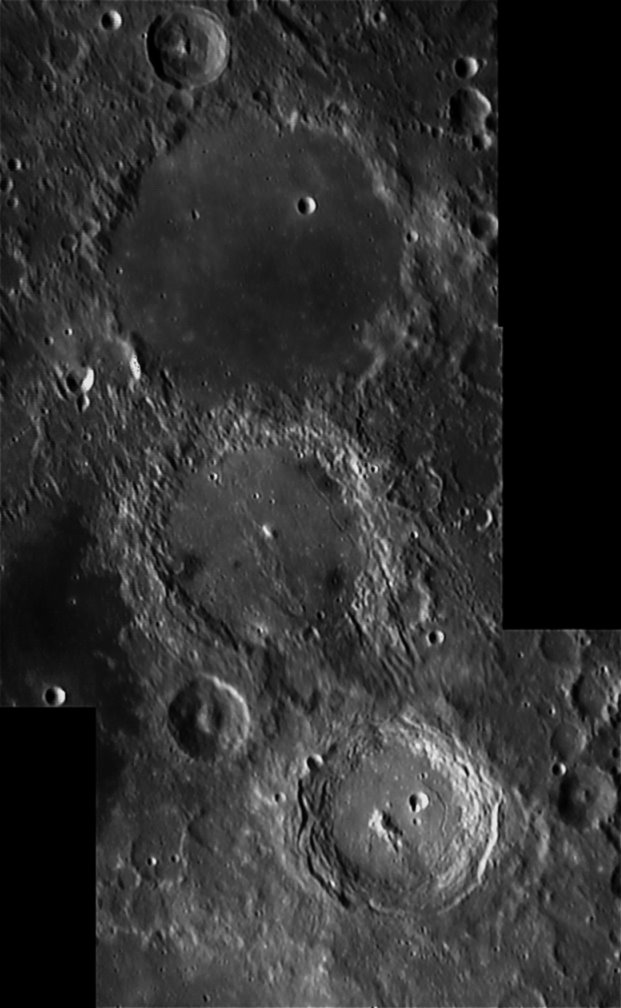
 2.5x Tele Vue, Toucam Pro. Some fair seeing, mostly bad.
Thursday, October 12, 2006
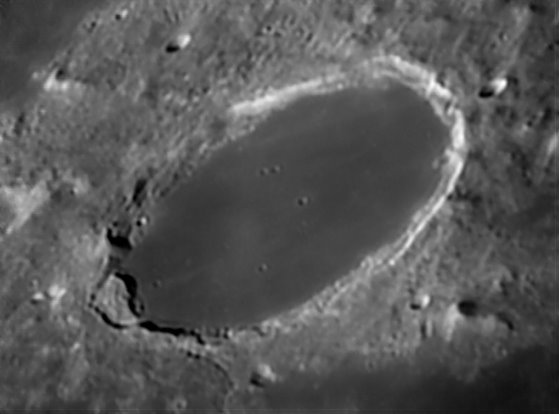
Ptolemaeus, Alphonsus & Arzachel 12th Oct 2006
2.5x Tele Vue, Toucam Pro. Some fair seeing, mostly bad.


Wednesday, October 11, 2006
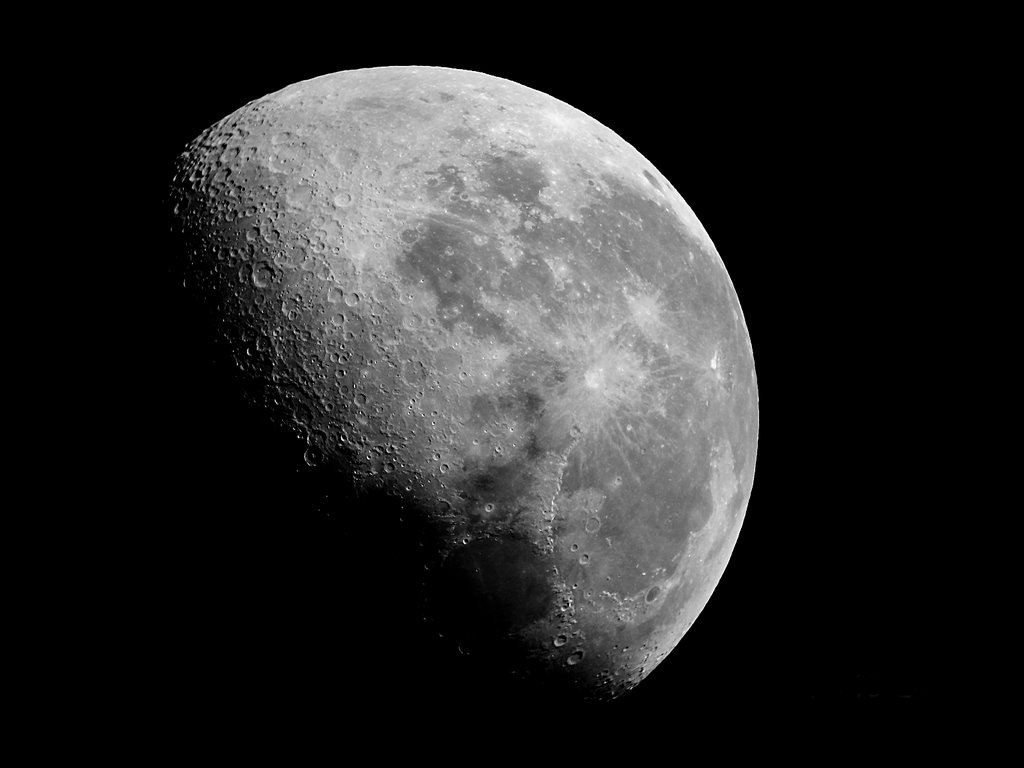
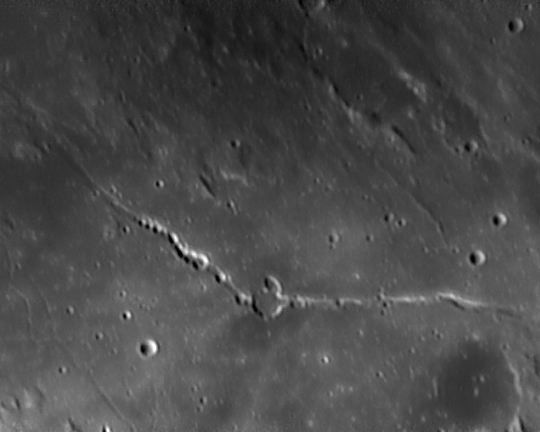
Cauchy and Fracastorius from 11th Oct 2006
 I leapt out of bed at 3:30 this morning to check the seeing for observing the Moon. The seeing wasn't very good, It was misty with clouds that completely obscured the view sometimes.
I thought because of the mist that the seeing would be better, but it was affecting the focus, turning it very blurred at times.
I managed to get a couple of half decent images though and an hour later went back to bed. :-)
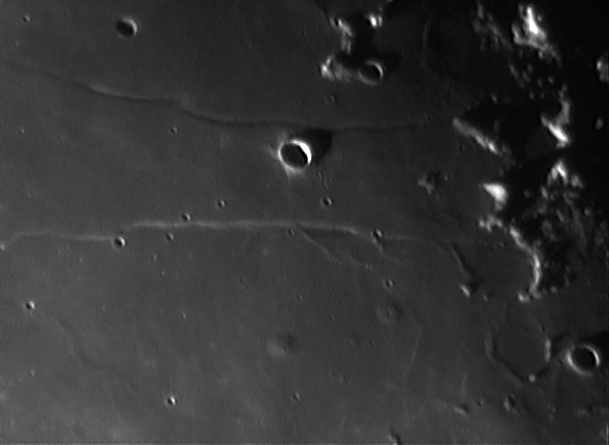
Cauchy is a small lunar impact crater on the eastern Mare Tranquillitatis. It is circular and symmetric, with a small interior floor at the mid-point of the sloping inner walls. Due to the high albedo of this bowl-shaped formation, it is particularly prominent at full moon. Just to the northeast of the rim of this crater is the wide rille named Rima Cauchy, a 210-kilometer-long cleft following a line to the northwest.
Southwest of Cauchy crater is a 120-km fault in the surface named the Rupes Cauchy. This wall parallels the Rima Cauchy to the northwest. South of Rupes Cauchy are two lunar domes designated Omega (ω) Cauchy and Tau (τ) Cauchy. They lie to the south and southwest of Cauchy crater respectively. Each lunar dome has a tiny craterlet at the crest.
wikipedia
AS8-13-2344.jpg via Kipp Teagues site
Orbiter Photo
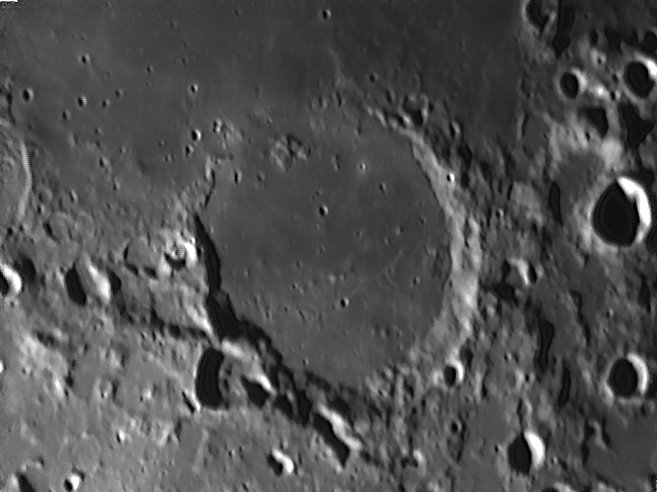 Fracastorius is the lava-flooded remnant of an ancient lunar impact crater located at the southern edge of Mare Nectaris. To the northwest of this formation lies the Beaumont crater, while to the northeast is Rosse.
The northern wall of this crater is missing, with only mounds appearing in the lunar mare to mark the outline. The lava that formed Mare Nectaris also invaded this crater, so the structure now forms a bay-like extension. The remainder of the rim is heavily worn and covered in lesser impact craters, leaving little of the original rim intact. The maximum elevation of the rim is 2.4 km. The most prominent of these craters is 'Fractastorius D', which overlays a portion of the western rim.
The Fracastorius crater has no central peak, but a long, slender rille runs across the middle of the floor in a generally east-west direction.
wikipedia
Sunday, October 08, 2006
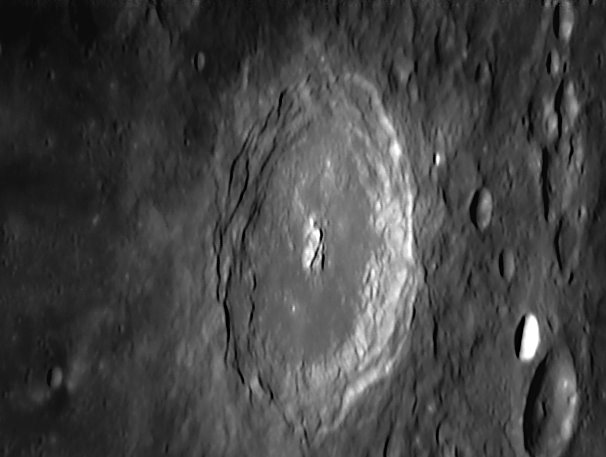


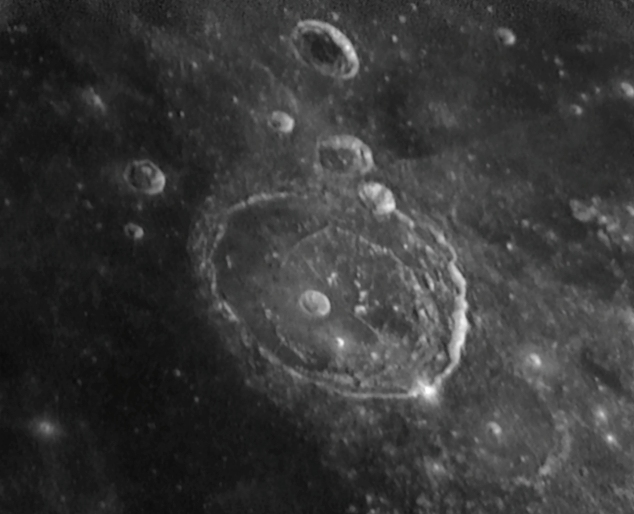

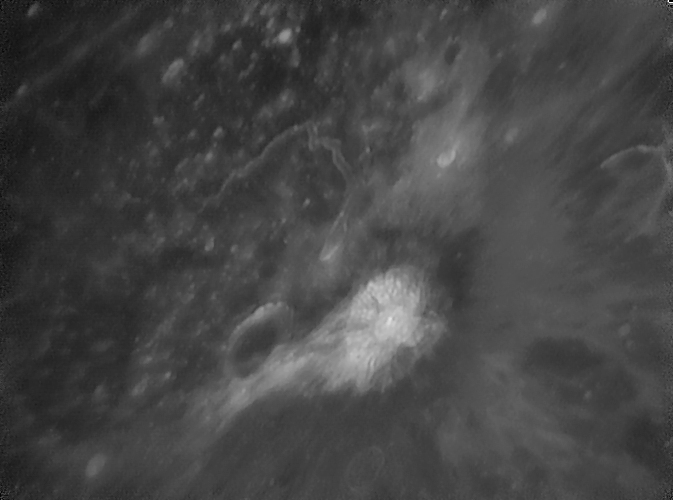
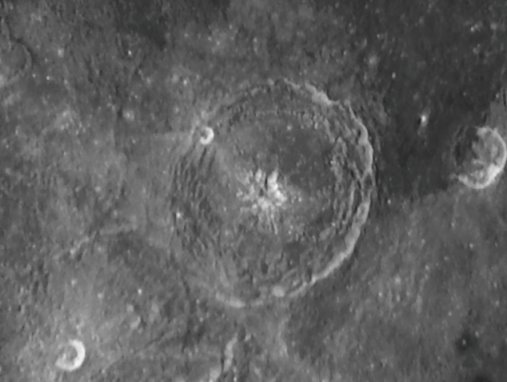


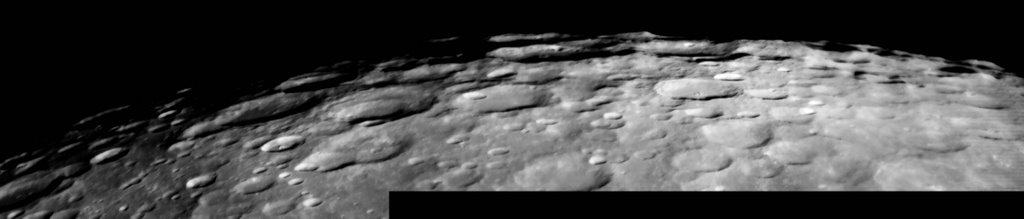
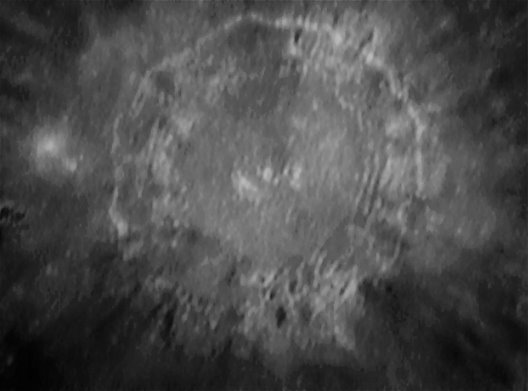
Messier & Messier A 8th Oct 2006
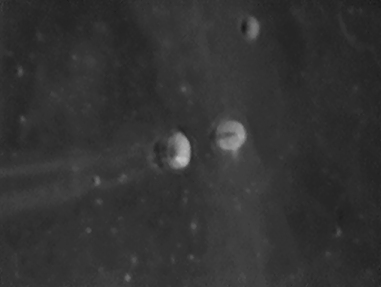 I took this with a Tele Vue 2.5x Powermate and a Celestron 2x Barlow together. The AVI was 3000 frames taken at 10fps. Most of it looked very blurrred/grainy and out of focus, but it processed to this. This image is shrunk by 75% to make it look a bit sharper.
The seeing was fair at times, but mostly rubbish.
Saturday, October 07, 2006
Friday, October 06, 2006


Thursday, October 05, 2006


Wednesday, October 04, 2006
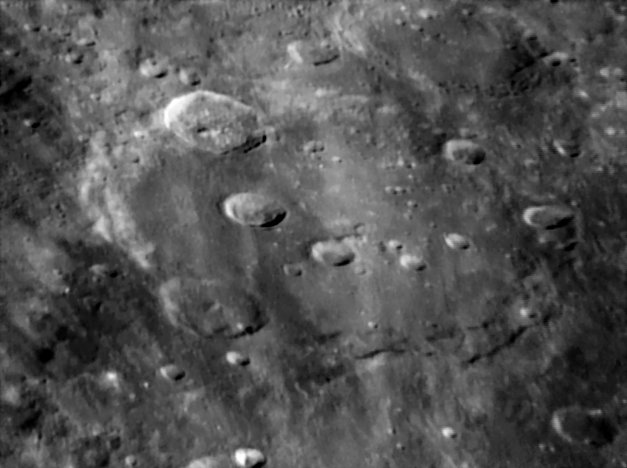
Cleomedes from 10th Sept 2006
 Cleomedes is a prominent lunar crater located in the northeast part of the visible Moon, to the north of Mare Crisium. It is surrounded by rough ground with multiple crater impacts. The irregular Tralles crater is intruding into the northwest rim. To the east is the Delmotte crater. North of Cleomeses is a triple-crater formation with Burckhardt crater occupying the center.
The outer wall of this crater is heavily worn and eroded, especially along the southern part of the wall. The 'Cleomedes C' crater lies across the south-southwest rim. The crater floor is nearly flat, with a small central peak to the north of the mid-point, forming a linear ridge toward the north-northeast. There are several notable craterlets on the floor, including a pair of overlapping craters just inside the northwest rim.
A rille named the Rima Cleomedes crosses the northern floor, running southeast from the northwest rim. This rille branches in a fork after crossing the crater mid-line. Smaller clefts lie in the southeast part of the floor.
Wikipedia
Thursday, September 28, 2006
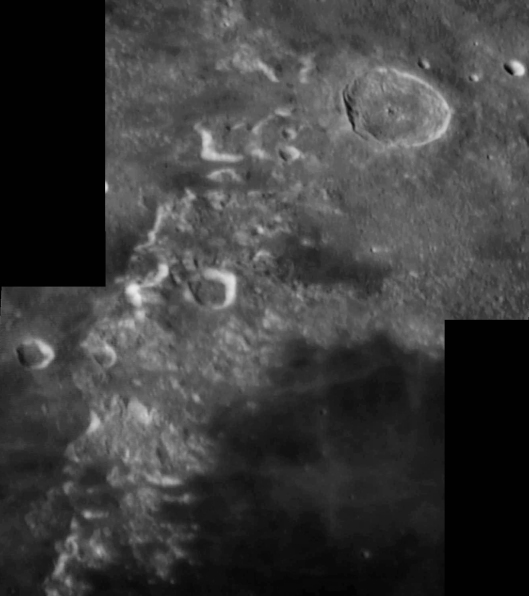
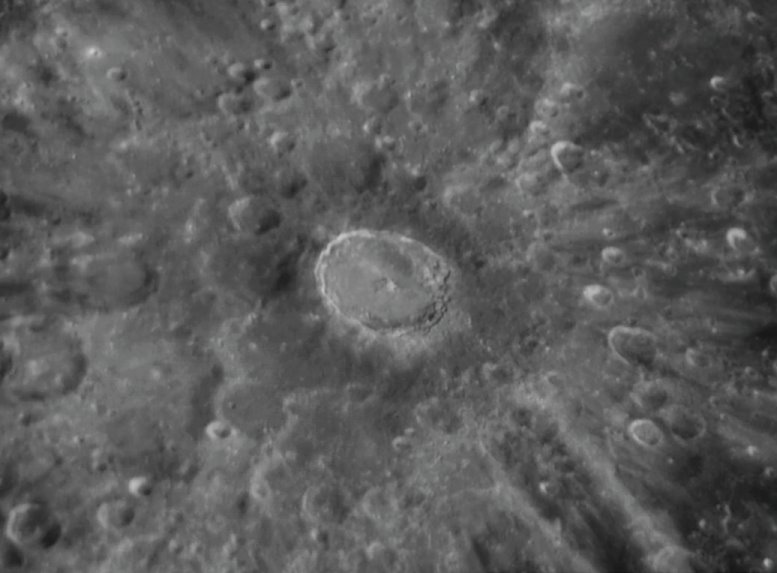
Atlas & Hercules 10th Sept 2006
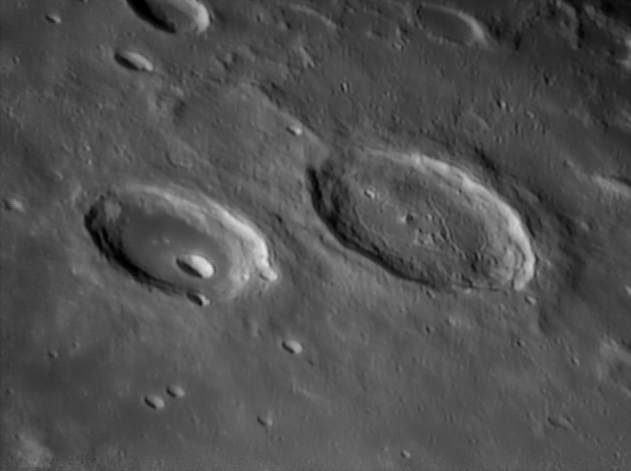 Atlas is a prominent lunar impact crater that is located in the northeast part of the Moon, to the southeast of Mare Frigoris. Just to the west is the slightly smaller but still prominent Hercules crater. Northeast of Atlas is the large Endymion crater.
The inner wall of the Atlas crater multiply terraced and the edge slumped, forming a sharp-edged lip. This is a floor-fractured crater with a rough and hilly interior that has a lighter albedo than the surroundings. Floor-fractures are usually created as a result of volcanic modifications.
There are two dark patches along the inner edge of the walls; one along the north edge and another besides the southeast edges. A system of slender clefts named the Rimae Atlas crosses the crater floor, and were created by volcanism. Along the north and northeastern inner sides are a handful of dark-halo craters, most likely formed due to eruptions. Around the mid-point is a cluster of low central hills arranged in a circular formation.
Hercules is a prominent crater located in the northwest part of the Moon, to the east of Atlas crater. It lies along the east edge of a southward extension in the Mare Frigoris. To the west across the mare is the Bürg crater. To the south is the ruined crater Williams.
The interior walls of Hercules have multiple terraces, and there is a small outer rampart. The crater floor has been flooded by lava in the past, and contains several areas of low albedo. The central peak has been buried, leaving only a low hill near the mid-point. The satellite crater 'Hercules G' crater is located prominently just to the south of the center. The small crater 'Hercules E' lies along the southern rim of Hercules.
In the past this crater has been reported as the site of some transient lunar phenomenon.
Wikipedia
Tuesday, September 26, 2006
Monday, September 18, 2006
Televue 5 x Powermate

I ordered a Powermate at the weekend from Telescope House.
It's coming tomorrow, I'll tell ya all about it. :-)
Wednesday, September 13, 2006

Tuesday, September 12, 2006
Seeing.
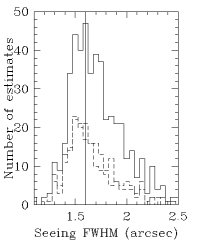 I found a golden rule to be untrue last night. The golden rule that I'm talking about is:-
'Seeing is bad after rain or a storm'
We had thunder and lightning storms yesterday evening, in fact a house just down the road from where I live was struck by lightning, and caught the roof alight.
I went out last night about 3 am to do some Moon imaging. There was a fair amount of cloud about, but in between some clear patches. To my amazement the 'seeing' was very good.
Just goes to show.




Sunday, September 10, 2006



Saturday, September 09, 2006



Subscribe to:
Posts (Atom)