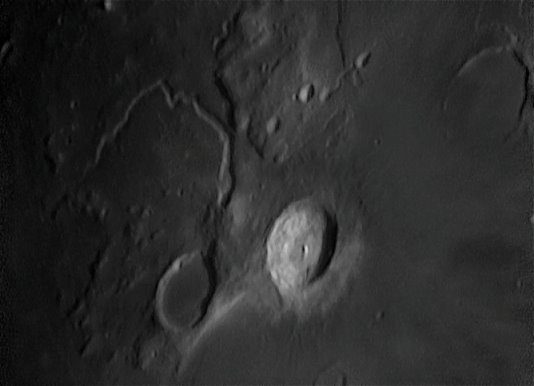
Six image mosaic.
Compare to this.
Vallis Schröteri is a sinuous valley on the surface of the Moon. It is located on a rise of continental ground, sometimes called the Aristarchus plateau, that is surrounded by the Oceanus Procellarum to the south and west and the Mare Imbrium to the northwest. At the southern edge of this rise are the craters Aristarchus and Herodotus.
This is the largest such sinuous valley formation on the Moon. It begins at a 6 km diameter crater located 25 km to the north of Herodotus. (The start of the valley has been termed the "Cobra's Head" by some observers, due to its resemblance to a snake.) From the crater it follows a meandering path, first to the north, then setting a course toward the northeast, before finally bending back to the south until it reaches a 1 km high precipice at the edge of the Oceanus Procellarum. The valley has a maximum width of about 10 km, then gradually narrows to less than a kilometer near its terminus.
The origins of this valley are believed to be volcanic. The interior floor has been resurfaced and is very level. However there is a slender rille located on the floor. This rille is not visible to observers on the Earth.
The selenographic coordinates of this valley are 26.2° N 50.8° W, and it has a maximum diameter of 168 km. It is named for Johannes H. Schröter.
Wikipedia


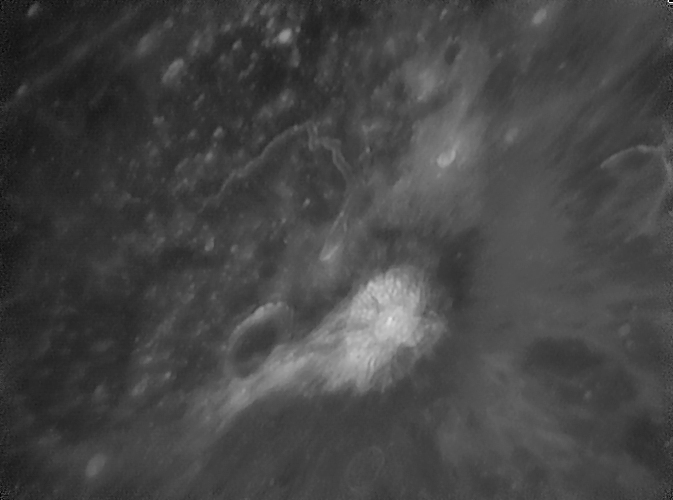
 7 image mosaic.


 Vallis Schröteri is a sinuous valley on the surface of the Moon. It is located on a rise of continental ground, sometimes called the Aristarchus plateau, that is surrounded by the Oceanus Procellarum to the south and west and the Mare Imbrium to the northwest. At the southern edge of this rise are the craters Aristarchus and Herodotus.


 Tricky one to process this. Very bright crater centre.