Showing posts with label taurus littrow. Show all posts

Sunday, July 19, 2009

LRO.

We're starting to get some hi-res images from LRO now.

Here is a portion near the Apollo 14 landing site in Fra Mauro that I've picked because I love those 'house sized' boulders. I think the crater is over a mile wide.


Below the Apollo 14 landing site.


Bottom two, Apollo 17 Spilt rock (Tracey rock) and Panorama taken at the time by the crew.


Credit NASA

Tuesday, December 23, 2008

New images from Apollo Image Archive

Here's some new images from the Apollo Image Archive that I've picked out. Some of my favourite areas.
These are all from the mapping cameras of either Apollo 16 or 15.
They have been cropped and "Shadows/Highlights" (brilliant tool) adjusted in CS3.

Messier craters.

Interesting section of Schröter's Valley.

Hadley Rille; Apollo 15 landing site.

Taurus Littrow; Apollo 17 landing site.

Friday, August 31, 2007

Apollo 17 site.

300/2000 frame, 3x TV Barlow.


Saturday, January 27, 2007

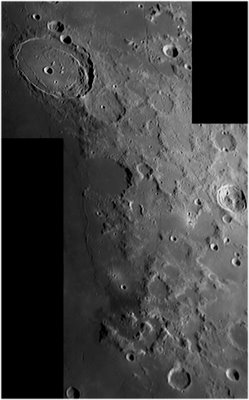
Posidonius to Littrow

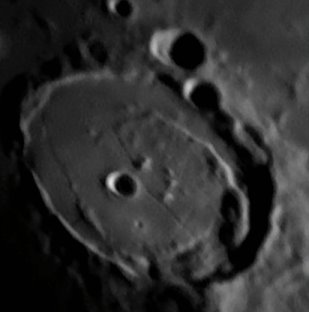
Posidonius is a lunar impact crater that is located on the western edge of Mare Serenitatis, to the south of Lacus Somniorum. The Chacornac crater is attached to the southeast rim, and to the north is Daniell crater.

The rim of Posidonius is shallow and obscured, especially on the western edge, and the interior has been overlaid by a lava flow in the past. The crater ramparts can still be observed to the south and east of the crater rim, and to a lesser degree to the north.

There is a smaller, semi-circular rim of a concentric, flooded crater within the main rim, offset toward the eastern edge. There is no central peak, but the floor is hilly and laced with a rille system named the Rimae Posidonius. The floor is also slightly bulged due to the past lava uplift, which also likely produced the complex of rilles. The northeast rim is interrupted by the smaller crater 'Posidonius B'. Within the crater rim, offset just to the west of center is another smaller crater 'Posidonius A'.

On the Mare Serenitatis surface near Posidonius crater is a notable system of wrinkle-ridges that parallel the nearby shore. These are designated the Dorsa Smirnov. At the peak of these ridges is a small craterlet with a diameter of 2 km. This craterlet is surrounded by a patch of high-albedo material, and is an example of a lunar bright spot. This peak was formerly designated Posidonius Gamma (γ).

The Posidonius Gamma feature was first observed by the lunar cartographer Julius Schmidt in 1857. He noted the similarity to the bright patch surrounding Linné crater.

Wikipedia

Thursday, April 13, 2006

Wednesday, April 05, 2006

Various from 5th April 2006 Moon

Albategnius-Klein
Aristoteles

Ariadaeus Rille

Rima Hyginus

Theophilus
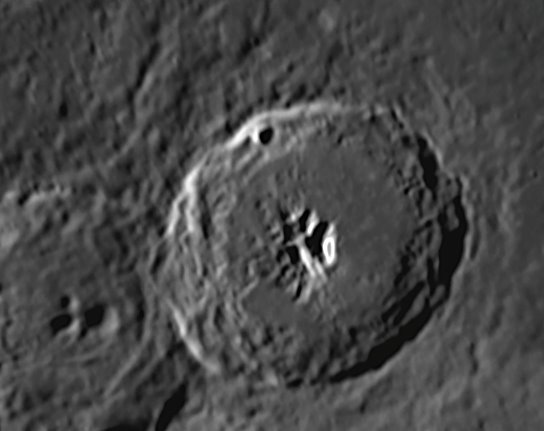
Littrow
Posidonius

Monday, March 06, 2006

Various from 6th March Moon.

Apollo 17 landing site; Taurus Littrow


Posidonius


Theophilus

Various from 5th March Moon.

Apollo 17 landing site; Taurus Littrow


Posidonius


Theophilus


Fabricius

Friday, November 18, 2005

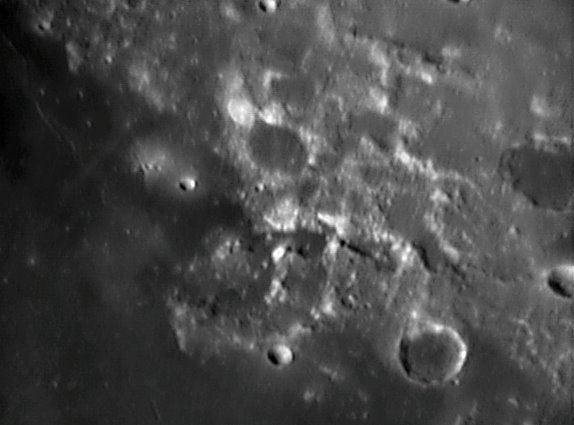
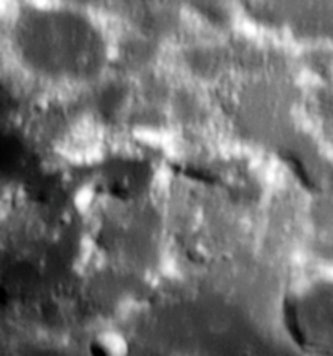
Apollo 17 landing site

Two views of the landing site. The first one taken using a 2x Celestron Barlow and the one below a 4x Imagemate made by BC&F.


Below is a link to a Hubble space telescope picture, for reference:-

http://imgsrc.hubblesite.org/hu/db/2005/29/images/m/formats/web.jpg

... and the Apollo 17 mapping camera image:-

http://www.lpi.usra.edu/resources/apollo/frame/?AS17-M-0597