Thursday, December 21, 2006
Sunday, December 17, 2006
Saturn: re-processed
 Slightly better seeing tonight, compared to the previous few weeks. However, there is still a lot of jetstream interference causing the image to go out of focus. I also found after taking these images that my collimation was a bit out, but, by the time I fixed it, the seeing was really bad, and my corrector plate was dewed over. So I called it a day... at 5:30am... sleeeeeep :-)
The top image was taken with my 4 x Imagemate (great lens) and reduced to 80% to make it a bit more snappy.
The lower image was taken with my 2.5 x Powermate (another super lens).
Sorry if the images look a bit dull, but at this point in time Saturn is dull, it's a long way away. The colours are almost what you see, looking through the scope.


Saturday, December 16, 2006

Friday, December 15, 2006


Wednesday, December 13, 2006

Tuesday, December 12, 2006

Thursday, December 07, 2006

Tuesday, December 05, 2006


Sunday, December 03, 2006


Saturday, December 02, 2006


Wednesday, November 29, 2006
Mars Rover Beginning To Hate Mars
 This is funny... how can you tell that the seeing right now is crap?
Tuesday, November 28, 2006

Friday, November 24, 2006

Tuesday, November 21, 2006
Comet impact crater on Earth.
 The impact of an asteroid or comet several hundred million years ago, according to scientists, left scars in the landscape that are still visible in this International Space Station/Expedition 12 picture of an area in the Sahara Desert of northern Chad.
Info from NASA site; larger image.
Sunday, November 19, 2006
Saturn 19th Nov 2006

Saturn November 2006, distance of 843,241,359 miles and underneath a comparison from January 2006, distance 756,369,397 miles:-

Saturday, November 18, 2006

Friday, November 10, 2006

Tuesday, November 07, 2006
Langrenus & Petavius 7th Nov 2006
 The combined 12 image mosaic.
 6 image mosaic, using 2.5 x Tele vue Powermate.
 4 image mosaic.

Moretus & Tycho 2nd Oct 2006
 I was going to do one of those big sprawling 'walks' from Tycho to Moretus mosaics.
But the Clavius section didn't work out. It's amazing how much the seeing can vary from one moment to the next whilst imaging.
So here are the start and end bits, with the crappy middle bit sent to the null bucket ;-(

Monday, November 06, 2006


Sunday, November 05, 2006

Saturday, November 04, 2006


Aristarchus & Vallis Schröteri 3rd Nov 2006
Six image mosaic. Compare to this.
 Vallis Schröteri is a sinuous valley on the surface of the Moon. It is located on a rise of continental ground, sometimes called the Aristarchus plateau, that is surrounded by the Oceanus Procellarum to the south and west and the Mare Imbrium to the northwest. At the southern edge of this rise are the craters Aristarchus and Herodotus.
This is the largest such sinuous valley formation on the Moon. It begins at a 6 km diameter crater located 25 km to the north of Herodotus. (The start of the valley has been termed the "Cobra's Head" by some observers, due to its resemblance to a snake.) From the crater it follows a meandering path, first to the north, then setting a course toward the northeast, before finally bending back to the south until it reaches a 1 km high precipice at the edge of the Oceanus Procellarum. The valley has a maximum width of about 10 km, then gradually narrows to less than a kilometer near its terminus.
The origins of this valley are believed to be volcanic. The interior floor has been resurfaced and is very level. However there is a slender rille located on the floor. This rille is not visible to observers on the Earth.
The selenographic coordinates of this valley are 26.2° N 50.8° W, and it has a maximum diameter of 168 km. It is named for Johannes H. Schröter.
Wikipedia
Friday, November 03, 2006


Thursday, November 02, 2006


Thursday, October 12, 2006
Ptolemaeus, Alphonsus & Arzachel 12th Oct 2006
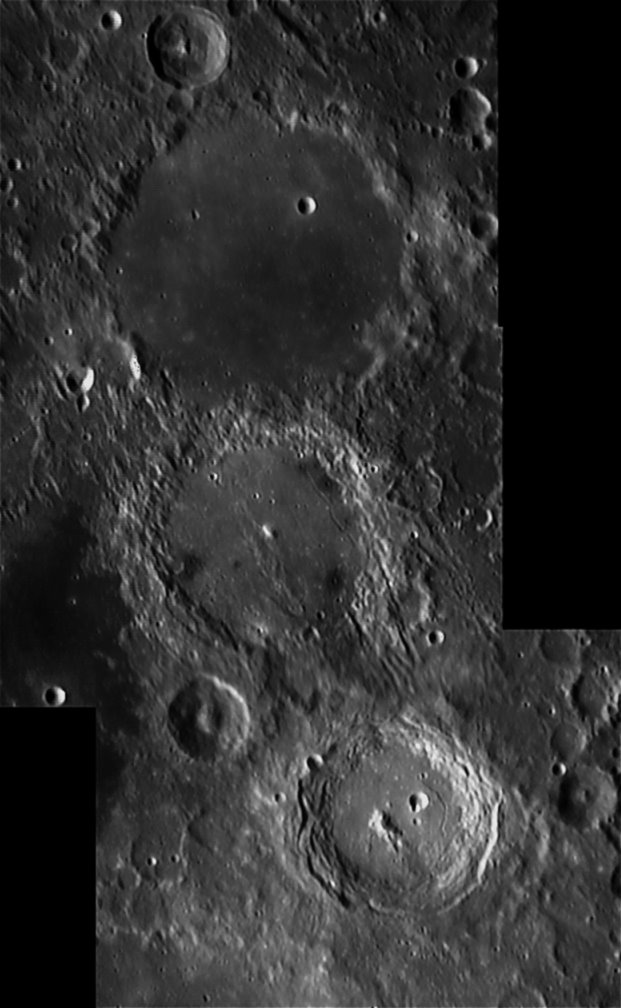 2.5x Tele Vue, Toucam Pro. Some fair seeing, mostly bad.

Wednesday, October 11, 2006
Cauchy and Fracastorius from 11th Oct 2006
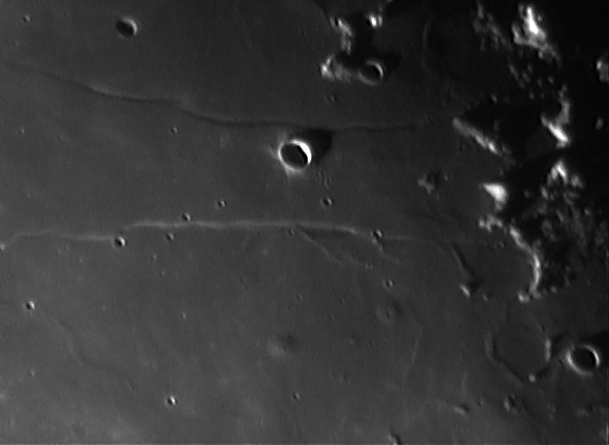 I leapt out of bed at 3:30 this morning to check the seeing for observing the Moon. The seeing wasn't very good, It was misty with clouds that completely obscured the view sometimes.
I thought because of the mist that the seeing would be better, but it was affecting the focus, turning it very blurred at times.
I managed to get a couple of half decent images though and an hour later went back to bed. :-)
Cauchy is a small lunar impact crater on the eastern Mare Tranquillitatis. It is circular and symmetric, with a small interior floor at the mid-point of the sloping inner walls. Due to the high albedo of this bowl-shaped formation, it is particularly prominent at full moon. Just to the northeast of the rim of this crater is the wide rille named Rima Cauchy, a 210-kilometer-long cleft following a line to the northwest.
Southwest of Cauchy crater is a 120-km fault in the surface named the Rupes Cauchy. This wall parallels the Rima Cauchy to the northwest. South of Rupes Cauchy are two lunar domes designated Omega (ω) Cauchy and Tau (τ) Cauchy. They lie to the south and southwest of Cauchy crater respectively. Each lunar dome has a tiny craterlet at the crest.
wikipedia
AS8-13-2344.jpg via Kipp Teagues site
Orbiter Photo
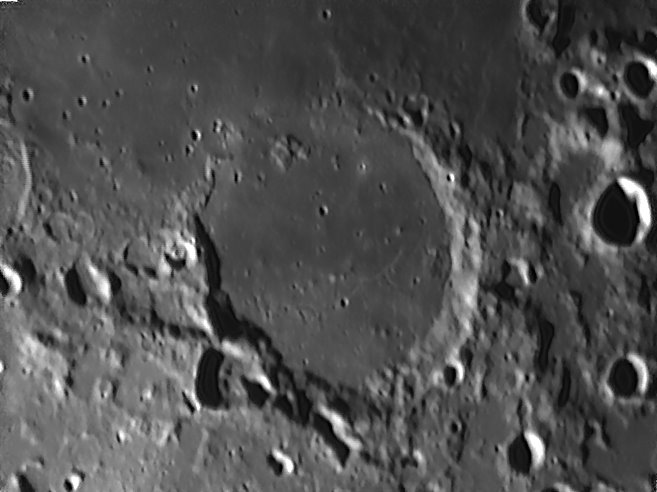 Fracastorius is the lava-flooded remnant of an ancient lunar impact crater located at the southern edge of Mare Nectaris. To the northwest of this formation lies the Beaumont crater, while to the northeast is Rosse.
The northern wall of this crater is missing, with only mounds appearing in the lunar mare to mark the outline. The lava that formed Mare Nectaris also invaded this crater, so the structure now forms a bay-like extension. The remainder of the rim is heavily worn and covered in lesser impact craters, leaving little of the original rim intact. The maximum elevation of the rim is 2.4 km. The most prominent of these craters is 'Fractastorius D', which overlays a portion of the western rim.
The Fracastorius crater has no central peak, but a long, slender rille runs across the middle of the floor in a generally east-west direction.
wikipedia
Subscribe to:
Posts (Atom)