Wednesday, February 28, 2007
Video from Clavius capture.
 Click on image to see a small portion of video from the Clavius capture the other night
This shows the seeing conditions for the 26th Feb 2007 session.
DivX


Monday, February 26, 2007
Various Moon from 26th Feb 2007
 4 image mosaic, 2.5x Powermate.


4 image mosaic, the lower right quadrant is a bit duff! the seeing was getting pretty bad by then.

The seeing wasn't really up to using my 4x Imagemate Barlow... but I'd thought I'd give it a go with Pitatus here.

Sunday, February 25, 2007
New Horizons Long Range Reconnaissance Imager - Jupiter.
 The New Horizons Long Range Reconnaissance Imager took this 2-millisecond exposure of Jupiter at 04:41:04 UTC on January 24, 2007. The spacecraft was 57 million kilometers (35.3 million miles) from Jupiter, closing in on the giant planet at 41,500 miles (66,790 kilometers) per hour. At right are the moons Io (bottom) and Ganymede; Ganymede's shadow creeps toward the top of Jupiter's northern hemisphere.
Two of Jupiter's largest storms are visible; the Great Red Spot on the western (left) limb of the planet, trailing the Little Red Spot on the eastern limb, at slightly lower latitude. The Great Red Spot is a 300-year old storm more than twice the size of Earth. The Little Red Spot, which formed over the past decade from the merging of three smaller storms, is about half the size of its older and "greater" counterpart.
From New Horizons website
Credit: NASA/Johns Hopkins University Applied Physics Laboratory/Southwest Research Institute
Mission: Rosetta flyby of Mars.
 True-colour image of Mars seen by OSIRIS.
From the ESA site; The first true-colour image generated using the OSIRIS orange (red), green and blue colour filers. The image was acquired on 24 February at 19:28 CET from a distance of about 240 000 km; image resolution is about 5 km/pixel.
Photo Credits: ESA © 2007 MPS for OSIRIS Team.
Cassini Saturn image 20th Feb 2007
 Here's a lovely image from the Cassini website showing the south pole.
Credit: CICLOPS/Space Science InstituteBoulder, CO
Moon from 22nd Feb 2007
Here's a couple from the 22nd, I wasn't going to process them, but they weren't as bad as I thought. Seeing wasn't that great, but it's the first time it's been clear for bloody ages!


Saturday, February 24, 2007
Saturn from 4th Feb re-processed.
 Re-processed using MAP processing in Registax 4. 5 Alignment points, 2000 frames. Re-sampled at 1.5 times.
Saturday, February 17, 2007
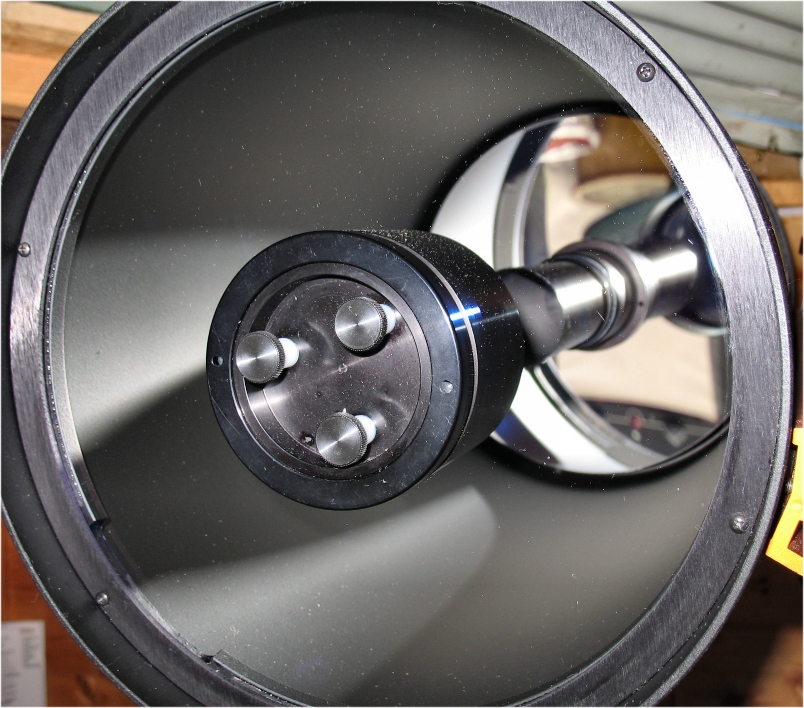
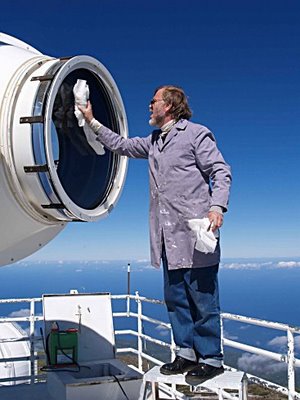
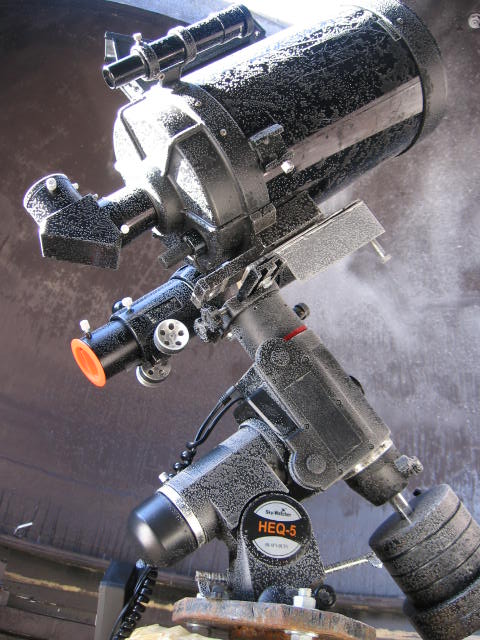
Cleaning my Corrector plate
 Here are the photo's that I took whilst cleaning my corrector plate. I used the instructions on the Starizona website, and it worked great. Only took a few minutes.
Ingredients:-
Isopropyl alcohol & Distilled water, mixed 50:50
100% Cotton balls
Soft brush (make-up Blusher brush, in a handy container, from Boots Chemist)
BTW I've had this scope over a year now and this is the first time I've cleaned it. You can see it needed it!

Thursday, February 15, 2007
Cleaning Optics.
 Here's a good site telling you how to clean your optics... I'll be doing this soon (my corrector plate is a mess), so I'll tell you how I get on.
Tuesday, February 13, 2007

Wednesday, February 07, 2007
Tuesday, February 06, 2007
Sunday, February 04, 2007
Re-sampled version of Saturn 00:51
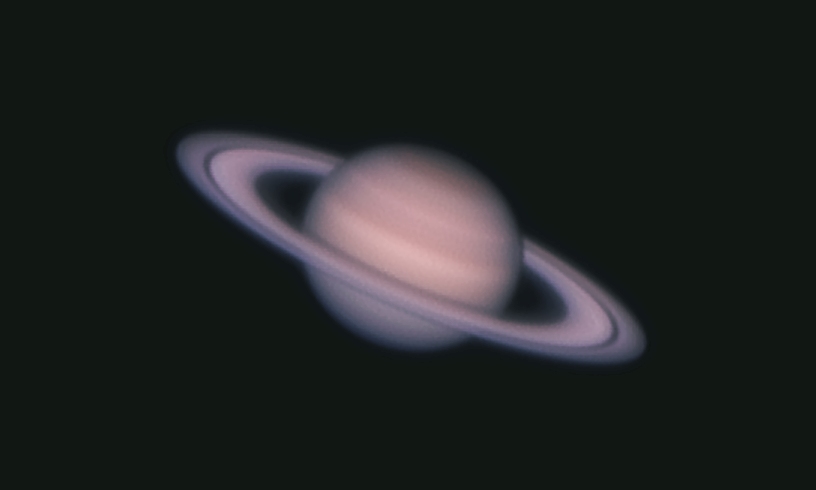 I was really lucky with the seeing last night. I came back out after midnight to do some more imaging, and the seeing was good. By the time I took this last AVI the seeing was very good, but soon after it went back to good and then bad. And that was it. ;-)
The Toucam (as everyone knows) suffers a lot from noise, so at f/40 the gain has to be about 50%, and the gamma around midway. To disguise some of the noise I've blurred the image. It gives it a nice dreamy, surreal look, don't you think? Mabey not strictly scientific, but that's processing for ya!
More Saturn from the 4th Feb 2007
 Top image; 4x Imagemate and barlow extension tube.
 4x Imagemate.
 5fps

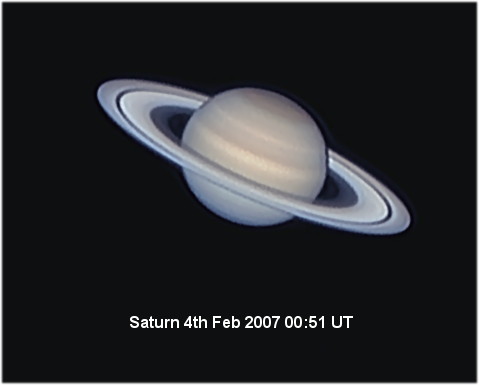
Best Saturn to date; 4th Feb 2007 (3 versions)
Image below re-processed in 2009 with Photoshop CS4.


C9.25, 4x Imagemate, Toucam Pro, Registax 4, Paintshop Pro, 2000/3000 frame avi @10fps.
3 versions of the same thing... take ya pick!

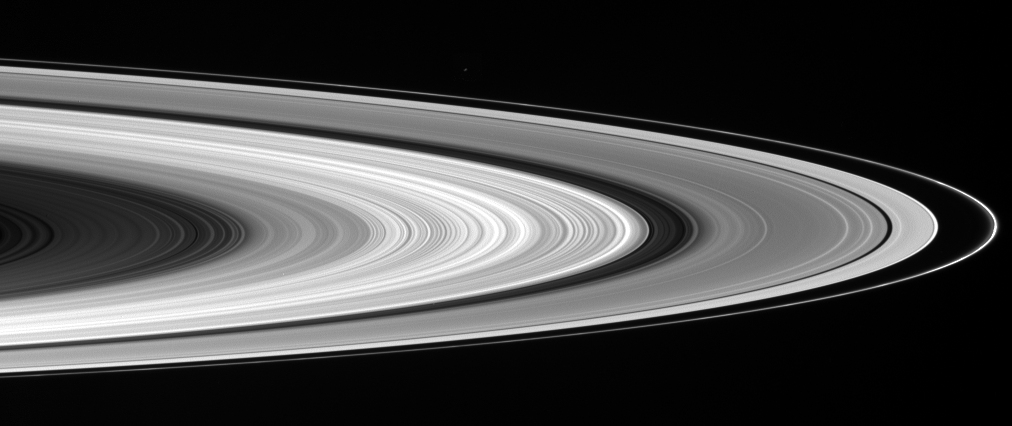
 Saturn from the Cassini spacecraft.


C9.25, 4x Imagemate, Toucam Pro, Registax 4, Paintshop Pro, 2000/3000 frame avi @10fps.
3 versions of the same thing... take ya pick!
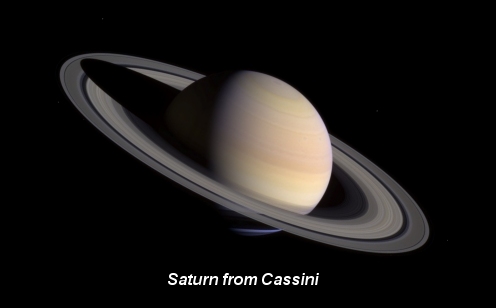 Saturn from the Cassini spacecraft.
Friday, February 02, 2007


Wednesday, January 31, 2007

Saturn 30th Jan 2007 and 21st Jan 2006 Comparison
Comparison with 'best' image of Saturn from last year, (which I re-processed yet again today).


Tuesday, January 30, 2007
Mars re-processed from 2005.

Mars re-processed from the year before last... can you believe it? Using new techniques.
Looking back in the archives.

Monday, January 29, 2007
Saturn re-processed.
 C9.25, Toucam Pro, 4x Imagemate, 10fps, best 500/2000 stack, Registax 4, Paintshop Pro.
The Apennines 27th Jan 2007
 Montes Apenninus are a rugged mountain range on the northern part of the Moon's near side. They named for the Apennine Mountains in Italy.
This range forms the southeastern border of the large Mare Imbrium lunar mare. It begins just to the west of the prominent Eratosthenes crater, which is abutted against the southern face of the range. To the west of these mountains is a narrow gap where Mare Imbrium in the north joins Mare Insularum to the south. Further to the west are the Montes Carpatus mountains.
From Eratosthenes, the mountains form an arcing chain that gradually bends from east to northeast, ending at Promontorium Fresnel at about latitude 29.5° N. Here is another gap where the Mare Imbrium to the west joins the Mare Serenitatis to the east. At the north end of this gap lie the Montes Caucasus.
Wikipedia
 Map from LPI.
Sunday, January 28, 2007
Theophilus 25th Jan 2007
 Theophilus is a prominent lunar impact crater that lies between Sinus Asperitatis in the north and Mare Nectaris to the southeast. It partially intrudes into the comparably-sized Cyrillus crater to the southwest. To the east is the smaller Mädler crater and further to the south-southeast is Beaumont crater. To the west-northwest is Mons Penck, a peak forming a promontory arm on the Rupes Altai.
The Rev. T. W. Webb described this as "the deepest of all visible craters". The rim of Theophilus crater has a wide, terraced inner surface that shows indications of landslips. The exterior has a wide, wrinkled rampart that descends about 1.4 kilometers to the surrounding maria. The largest impact crater of significance on the wall is the small Theophilus B on the inside of the northwest rim. Most of the rays from this crater have been weathered away, although a few are still visible.
The floor of the crater is relatively flat, and it has a large, triple-peaked central crater that climbs to a height of about 2 kilometers above the floor. The western peak is designated Psi (ψ), the eastern Phi (φ), and the northern peak is Alpha (α) Theophilus. The western slopes of this ridge are wider and more irregular, whereas the peaks descend more sharply to the floor on the northern and western faces.
The Apollo 16 mission collected several pieces of basalt that are believed to be ejecta from the formation of the Theophilus crater.
Wikipedia
 Apollo 16 Mapping camera.
Saturday, January 27, 2007
Saturn & Titan 27th Jan 2007

Titan (tye'-t?n, IPA: ['ta?tn?], Greek ??t??) or Saturn VI is the largest moon of Saturn and the second largest moon in the solar system, after Jupiter's moon Ganymede. It is roughly 50% larger than Earth's moon by diameter, and is larger by diameter and mass than all known dwarf planets. It is also larger by diameter than the planet Mercury, though Mercury is more than twice as massive.
Titan is the only moon in our solar system to have a dense atmosphere. Until very recently, this atmosphere inhibited understanding of Titan's surface, but the moon is currently undergoing study by the Cassini-Huygens mission, and new information about it is accumulating, such as the discovery of liquid hydrocarbon lakes near its north pole.
Titan was discovered on March 25, 1655 by the Dutch astronomer Christiaan Huygens, and was the first moon in the Solar System to be discovered after the Galilean moons of Jupiter.
Wikipedia
Pitatus and the Alpine Valley 27th Jan 2007
 Pitatus is an ancient lunar impact crater located at the southern edge of Mare Nubium. Joined to the northwest rim is Hesiodus crater, and the two are joined by a narrow cleft. To the south lie the attached Wurzelbauer and Gauricus craters.
The complex wall of Pitatus is heavily worn, and has been encroached by lava flows. The rim is lowest to the north, where the lava almost joins the Mare Imbrium. Near the middle is a low central peak that is offset to the northwest of center. This peak only rises to a height of 0.5 km.
Pitatus is a floor-fractured crater, meaning it was flooded from the interior by magma intrusion through cracks and openings. (See also the Gassendi and Posidonius craters for similar features.) The flooded crater floor contains low hills in the east and a system of slender clefts named the Rimae Pitatus. The larger and more spectacular of these rilles follow the edges of the inner walls, especially in the northern and eastern halves. The floor also contains the faint traces of deposited ray markings.
Just to the north of Pitatus in the neighboring maria is the half-buried rim of a lesser crater, covered in the past when Mare Nubium was formed.
 Vallis Alpes (latin for"Alpine Valley") is a spectacular lunar valley feature that bisects the Montes Alpes range. It extends 166 km from the Mare Imbrium basin, trending east-northeast to the edge of the Mare Frigoris. The valley is narrow at both ends and widens to a maximum width of about 10 km along the middle stretch. The selenographic coordinates of this feature are 48.5° N 3.2° E.
The valley floor is a flat, lava-flooded surface that is bisected by a slender, cleft-like rille. (This cleft is a challenging target for telescope observation from the Earth.) The sides of the valley rise from the floor to the surrounding highland terrain, a blocky, irregular surface. The southern face of the valley is straighter than the northern side, which is slightly bowed and uneven. The more rugged edges of the valley lie at the narrow west-southwest end that cuts through the mountain range. Most likely this valley is a graben that was subsequently flooded with magma.
This valley was discovered in 1727 by Francesco Bianchini.
Subscribe to:
Posts (Atom)