Sunday, August 31, 2008

Archimedes & Hadley Rille from Feb 2008

4 Image mosaic from earlier this year. I had trouble stitching this one together last February. I couldn't get the shades of the 4 images to match very well.
Now I used CS3 photomerge and it worked a lot better, nearly fully automatic using the interactive layout setting. Which is a bit of a must for Moon mosaics, I think one crater looks very similar to another for CS3 ;-)

Copernicus from 2007 - Best Copernicus to date.

Another rendering of my best Copernicus from last year. Using Registax and CS3.
5 image mosaic, best 200 from 2000 frame avi's, 42 x 64 box MAP.
I've gone for a slightly smoother feel with the 64 box MAP processing.

Friday, August 29, 2008

Tycho from August 2007 - Best Tycho to date.

Tycho from last year, re-processed again in Registax and CS3.
4 image mosaic. Best 200 frames from 1000 frame avi, MAP using 34 points each image.

Wednesday, August 27, 2008

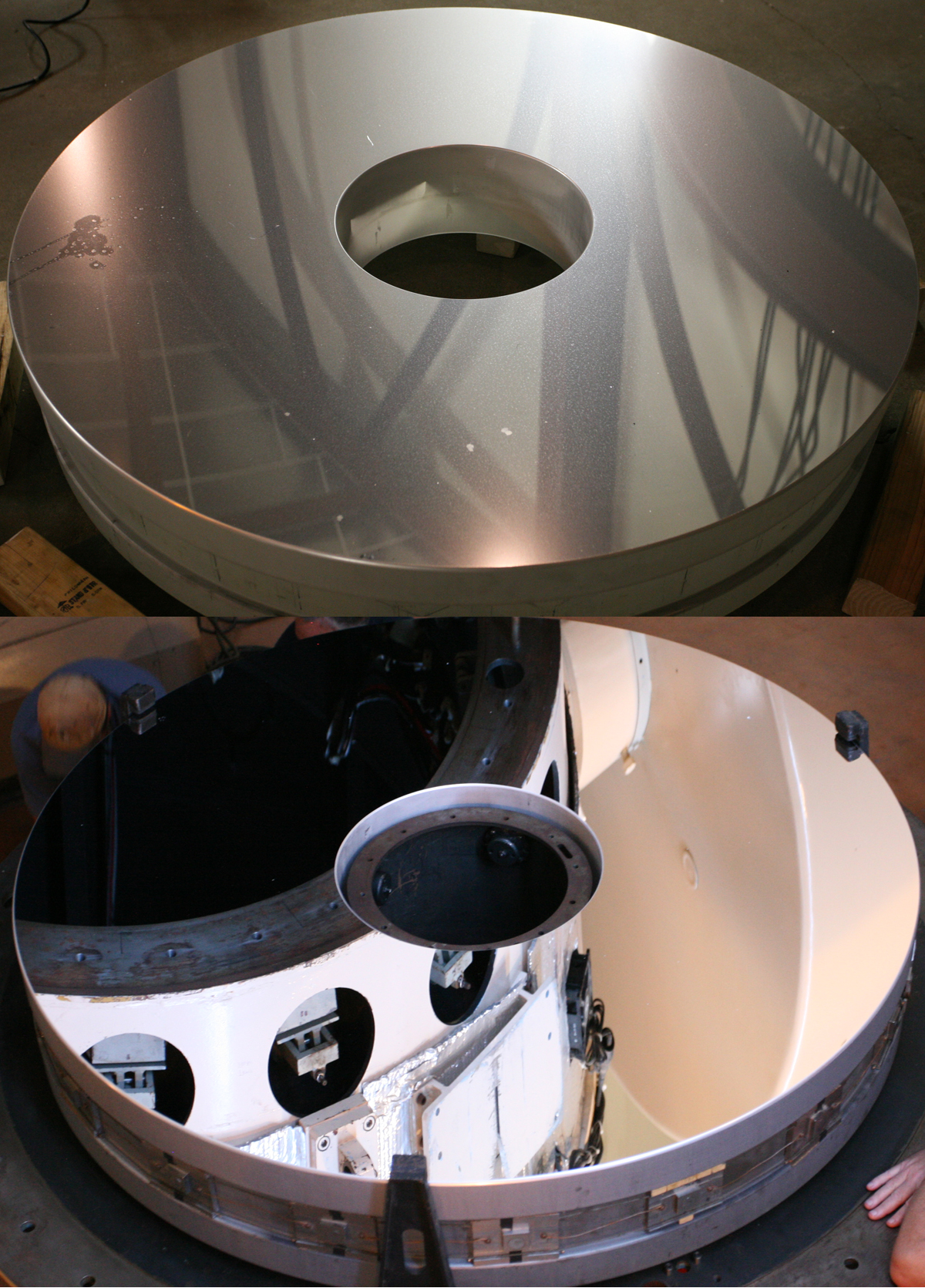
60-inch Aluminizing - The Palomar Observatory

What a difference an Aluminizing makes:-

Credit Palomar Skies

Monday, August 25, 2008

The Colour in the Solar System by Don davies

Here's an interesting article by Don Davies about the "Colour in the Solar System"

Southern Highlands - the directors cut.

I found some frames that I didn't process! so here is the full directors cut version.
... and the fullsize version - 1.9Mb

Below is an image taken from NASA's "World Wind" of a view just over the horizon.
I love that crater in the middle top; Drygalski, also visible in my image right on the top horizon.

Imagingsource blog entry

Saturday, August 23, 2008

Moon Southern Highlands 23rd Aug 2008

Moon mosaic 23rd Aug 2008


Full size version here.

I'm glad I upgraded my computer... these files are chunky!

The Moon 23rd Aug 2008

Friday, August 22, 2008

The Planetary Society Weblog article

Here's a very interesting article about asteroids/minor planets by Emily Lakdawalla from the Planetary Society Weblog.

Thursday, August 14, 2008

Space Shuttle Launch Seen From Air Canada Flight

This is amazing, click on the image above for a link to the video.

Sunday, August 10, 2008

OT: Computer advert


I love this retro computer ad.
Credit

Clavius from 2nd Sept 2007 re-processed with CS3


Here's one of my best Clavius images to date. Best 500 images stacked in Registax and mosaiced with CS3 Photomerge.

Some people prefer the so-say correct orientation, so here's two versions.

The lower version looks like the horizon is going into the distance underneath you, which is not very natural as far as I'm concerned ;-)

Saturday, August 09, 2008

Plato & Alpine Valley re-processed in Photoshop CS3

...and Registax, of course.

Saturday, August 02, 2008

Thursday, July 31, 2008

Sunday, July 27, 2008

The Moon 27th July 2008 - 04:48 BST

Jumped out of bed this morning at 4:30am to see if the Moon was visible... it was, so I dashed down to setup and take some hi-res Moon images. But the seeing wasn't that good. So I took a mosaic with the DMK camera and a few colour shots with the Canon 400D. I've merged them into this composite using Photoshop:-

Saturday, July 26, 2008

Midnight Sun on Mars

This panorama mosaic of images was taken by the Surface Stereo Imager on board NASA's Phoenix Mars Lander. This mosaic documents the midnight sun during several days of the mission.

Credit

Thursday, July 24, 2008

M57 24th July 2008

20 x 2min Frames.

Mare Imbrium 24th July 2008

Tuesday, July 22, 2008

Pink clouds 22nd July 2008

Jupiter & moons

Wow it's clear!, well a bit.
Jupiter was very low on the horizon, but at prime focus I was able to image it and get some sort of result. Like looking through jelly. The moons looked good though.

I also spent the rest of the night imaging M57 with a 2x barlow, but they didn't turn out too well. I think this was down to the transparency, or lack of it! ;-(

Friday, July 18, 2008

Japan's JAXA/SELENE satellite Tycho fly-by.

This is incredible. A computer generated fly-by of the Crater Tycho taken by Japan's JAXA/SELENE satellite.

Click on image for the video link.

Thursday, July 17, 2008

Wet Environments on Ancient Mars.

A colour-enhanced image of the delta in Jezero Crater, which once held a lake. Ancient rivers ferried clay-like minerals (shown in green) into the lake, forming the delta. Clays tend to trap and preserve organic matter, making the delta a good place to look for signs of ancient life.
Credit text: NASA

Image credit: NASA/JPL/JHUAPL/MSSS/Brown University.

Wednesday, July 16, 2008

The Hale Telescope.

The Hale Telescope... I don't have any excuse for showing this image... apart from the fact that it's one of my favourite telescopes, and it's still cloudy out there ;-)

Credit: Palomar Skies Blog

Saturday, July 12, 2008

Joke time.


Credit

Tuesday, July 08, 2008

M57 taken through guider scope.

Here's an interesting one. It's not supposed to be clear tonight, but it is so I thought I'd practice with guidescope setups and alike. This time I used the C9.25 as the guidescope and my guidescope lens as the capturing device. Here is 7 x 65 second frames from the DMK camera trained on M57. Processed in Registax, no flats, darks or bias.

Wide enough field for ya?

Time to batten down the hatches... we're supposed to be getting 40mm of rain tonight :-/

Happy birthday Gemma.

Saturday, July 05, 2008

M31... work in progress

... I need more subs ;-)
Had a quick gander at M31 before packing up on the 4th. This is 11 x 1600ISO frames at 2 minutes each.
The galaxy was very low in the sky, so the FWHM value was quite high.

Cosmic Quest - This is great.

Heather Couper continues her narrative history of the cosmos and our place within it.

Dumbbell 4th July 2007

Here's another M27 taken on 4th July, (Happy Birthday Leanne).
This is a DSS combination of the previous set of images taken on the 01/07/08 and a set of 28 x 2minute 1600ISO images taken on the 4th. I polar aligned the scope before taking the images, and therefore I didn't use DEC control in PHD. But there was a very small amount of trailing that I could detect, which had to be removed in PS using layering. Because of this the results are not quite as good as I hoped (the stars look like squashed eggs).
Still you live and learn.
The two set of images were quite a bit out of registration, but DSS matched them up perfectly.


Removing star trails:-
Using PS in layers duplicate the image (called a background copy), next change the background copies blending mode to darken,
with background copy highlighted, select the offset tool in filters
Filters>Other>Offset
(zoom in 500% on the image "Ctrl +") and adjust the horizontal/vertical pixels
(undefined areas set to wrap around).
For the full size picture I used Horizontal of "1" and Vertical of "2"...this will vary depending on the size of the trails and what direction they are heading....i.e. up and down...on a 45....sideways.... etc. ....play with the two settings until the trails are diminished or eliminated....you can use negative numbers.
Once you have the star shape where you want it, zoom back out, then flatten the image and save.
If the filter takes it a tad too far, go to the ..... Edit>Fade filter function and this will decrease the amount. (this must be done before you flattern)....play with it a couple of times.
Credit FWHM IMAGING FORUMS

Wednesday, July 02, 2008

Opportunity at Cape Verde (simulated)

An artist's impression of Opportunity exploring Cape Verde.
Credit: NASA / JPL / Cornell / Texas A & M / Rover model by D. Ellison / simulated view by Astro0

Tuesday, July 01, 2008

Dumbbell Nebula 1st July 2008


The image at the bottom is a single RAW frame that has been reduced in size and cropped.

Dumbbell capturing.

Here's a screen dump from one of my computer screens (running dual monitors you know, it's the only way to go with all these programs running at once).
This shows the PHD guiding window and graph, on the right is the DSLR shutter program.
The HC Buttons are a handy little scope controller that comes with PHD.

Question: Why that star on the left?
Answer: That's what you're supposed to do, pick a star off centre that isn't too bright. ;-)

Sunday, June 29, 2008

Loads of Stars

I finished the evening by wedging my Canon 400D on the scope and taking this 2 minute exposure in the general area of the milky-way.

M27 - Dumbbell Nebula - 29th June 2008

It's clear! panic stations, what do I do? what's around? the Dumbbell Nebula!
I didn't have enough subs, (because my corrector plate totally dewed over, I wondered why it was getting dark), but there is something there.
This is 12 frames, totalling 17mins 40s of exposure. No darks, flats or bias. Prime focus C9.25, guided with Push Here Dummy.
M27 is 1,250 Light years away.

Friday, June 27, 2008

"Storm Alley" - Cassini image

Amazing image of vortices and swirling storms in Saturn's upper atmosphere.
Credit NASA/JPL/Space Science Institute

A spiral density wave - Cassini's lastest ring images

The latest images for June from Cassini have just been released. There's structure in them there rings!
Credit NASA/JPL/Space Science Institute


An enhanced section from the above image.
Ring scientists think that the scrambled pattern seen here in the B ring's outer edge might represent gravitational clumping of particles there--that is, the self-gravity of groups of particles orbiting together makes them form clumps.


Thursday, June 26, 2008

Pluto

Tried to find Pluto last night.
It's very low on the horizon and I have to try and capture in between my house and next doors. I used my scopes GOTO, which was aligned before I started, and the scope tracked right down between the houses.
Using a 40mm EP I could see some very faint stars, but I didn't have a clue which one was Pluto. So I used my DMK camera to take some before and after pictures. I only had a limited time before my house obscured the view, so I don't think it was long enough to tell, using blink comparator between the images.
Also, I wasn't even sure that it was on the chip. Below is a processed image from about 20 x 5 sec framed AVI.
Next time I'll use the Canon DSLR, this will give me a wider field of view.
Another problem is finding star charts that go down to +13.9 magnitudes.