

Sunday, June 29, 2008
Loads of Stars
I finished the evening by wedging my Canon 400D on the scope and taking this 2 minute exposure in the general area of the milky-way.


M27 - Dumbbell Nebula - 29th June 2008
It's clear! panic stations, what do I do? what's around? the Dumbbell Nebula!
I didn't have enough subs, (because my corrector plate totally dewed over, I wondered why it was getting dark), but there is something there.
This is 12 frames, totalling 17mins 40s of exposure. No darks, flats or bias. Prime focus C9.25, guided with Push Here Dummy.
M27 is 1,250 Light years away.

I didn't have enough subs, (because my corrector plate totally dewed over, I wondered why it was getting dark), but there is something there.
This is 12 frames, totalling 17mins 40s of exposure. No darks, flats or bias. Prime focus C9.25, guided with Push Here Dummy.
M27 is 1,250 Light years away.

Friday, June 27, 2008
"Storm Alley" - Cassini image
Amazing image of vortices and swirling storms in Saturn's upper atmosphere.
Credit NASA/JPL/Space Science Institute

Credit NASA/JPL/Space Science Institute

A spiral density wave - Cassini's lastest ring images
The latest images for June from Cassini have just been released. There's structure in them there rings!
Credit NASA/JPL/Space Science Institute


An enhanced section from the above image.
Ring scientists think that the scrambled pattern seen here in the B ring's outer edge might represent gravitational clumping of particles there--that is, the self-gravity of groups of particles orbiting together makes them form clumps.


Credit NASA/JPL/Space Science Institute


An enhanced section from the above image.
Ring scientists think that the scrambled pattern seen here in the B ring's outer edge might represent gravitational clumping of particles there--that is, the self-gravity of groups of particles orbiting together makes them form clumps.


Thursday, June 26, 2008
Pluto
Tried to find Pluto last night.
It's very low on the horizon and I have to try and capture in between my house and next doors. I used my scopes GOTO, which was aligned before I started, and the scope tracked right down between the houses.
Using a 40mm EP I could see some very faint stars, but I didn't have a clue which one was Pluto. So I used my DMK camera to take some before and after pictures. I only had a limited time before my house obscured the view, so I don't think it was long enough to tell, using blink comparator between the images.
Also, I wasn't even sure that it was on the chip. Below is a processed image from about 20 x 5 sec framed AVI.
Next time I'll use the Canon DSLR, this will give me a wider field of view.
Another problem is finding star charts that go down to +13.9 magnitudes.

It's very low on the horizon and I have to try and capture in between my house and next doors. I used my scopes GOTO, which was aligned before I started, and the scope tracked right down between the houses.
Using a 40mm EP I could see some very faint stars, but I didn't have a clue which one was Pluto. So I used my DMK camera to take some before and after pictures. I only had a limited time before my house obscured the view, so I don't think it was long enough to tell, using blink comparator between the images.
Also, I wasn't even sure that it was on the chip. Below is a processed image from about 20 x 5 sec framed AVI.
Next time I'll use the Canon DSLR, this will give me a wider field of view.
Another problem is finding star charts that go down to +13.9 magnitudes.

Wednesday, June 25, 2008
Messier 57 from 10th June 2008
The famous ring nebula Messier 57 (M57, NGC 6720)
I took this a while back, I hadn't bothered to process it until now.
Didn't spend too much time on it.
A bunch of DMK 30 second exposures.

I took this a while back, I hadn't bothered to process it until now.
Didn't spend too much time on it.
A bunch of DMK 30 second exposures.

Wednesday, June 18, 2008
OT: New/Old ISP and network stuff.
Netgear wireless router and cable modem from Virgin Media & Netgear Gigabit switch that I bought for fast access between machines.

I signed up to a new ISP today, Virgin Media. Well, before I went to AOL ADSL I was with NTLworld, who were taken over by Virgin. So I'm now back with them... whoever they are.
The link is a bit zippier on Fibre Optic compared to ADSL, I'm too far away from the exchange in town for a decent ADSL speed.
I used to get 512kb/s on ADSL, now I get below with Virgin on cable... when the wind is in the right direction that is :-)


Good site for checking your ISP SPEEDTEST.NET
You'll be suprised!

I signed up to a new ISP today, Virgin Media. Well, before I went to AOL ADSL I was with NTLworld, who were taken over by Virgin. So I'm now back with them... whoever they are.
The link is a bit zippier on Fibre Optic compared to ADSL, I'm too far away from the exchange in town for a decent ADSL speed.
I used to get 512kb/s on ADSL, now I get below with Virgin on cable... when the wind is in the right direction that is :-)


Good site for checking your ISP SPEEDTEST.NET
You'll be suprised!


Contrails at night.
Took these pictures the other night of contrails. Thought they looked quite good actually.


Monday, June 16, 2008

Saturday, June 07, 2008
Phoenix ready to scoop.
Here's my RGB composite (using synthetic green) of the Phoenix scoop taken on Sol 11.

B&W images; Credit: NASA / JPL / UA

B&W images; Credit: NASA / JPL / UA
Thursday, June 05, 2008
High altitude Cirrus clouds and new Moon
Nice Cirrus clouds this evening.
Maybe clear tonight, first time for ages. I went on holiday three weeks ago and took my OTA out of the shed for safe keeping. This is the first opportunity I've had to put it back!


Maybe clear tonight, first time for ages. I went on holiday three weeks ago and took my OTA out of the shed for safe keeping. This is the first opportunity I've had to put it back!


Saturday, May 31, 2008
Phoenix Mars lander... Ice?

Here's a view from underneath the Phoenix lander... is this area disturbed by the landers thrusters ice?
It does look odd.
Credit NASA
Friday, May 30, 2008

Tuesday, May 27, 2008


Monday, May 26, 2008
Phoenix Mars lander being imaged by MRO on the way down.
Looks like it worked :-)

Photo credit: NASA/JPL-Caltech/University of Arizona

Enhanced image by Emily Lakdawalla

Credit: NASA / JPL / U. Arizona / Color composite by Emily Lakdawalla

Photo credit: NASA/JPL-Caltech/University of Arizona

Enhanced image by Emily Lakdawalla

Credit: NASA / JPL / U. Arizona / Color composite by Emily Lakdawalla
M92 - re-processed yet again.

It's really difficult to get accurate colours in astro photography, well it is for me.
Here's the results of a new technique that I've discovered.
Postcard from Phoenix Mars lander.
This false colour postcard image, one of the first captured by NASA's Phoenix Mars Lander, shows the vast plains of the northern polar region of Mars. The flat landscape is strewn with tiny pebbles and shows polygonal cracking, a pattern seen widely in Martian high latitudes and also observed in permafrost terrains on Earth. The polygonal cracking is believed to have resulted from seasonal freezing and thawing of surface ice.

The B&W image below was acquired at the Phoenix landing site on day 1 of the mission on the surface of Mars, or Sol 0, after the May 25, 2008, landing. The surface stereo imager left acquired this image at 17:07:41 local solar time.


Stereo anaglyph produced my me.

... or the Stereo card version, where you cross your eyes, which I prefer.
Photos & text credit: NASA/JPL-Caltech/University of Arizona

The B&W image below was acquired at the Phoenix landing site on day 1 of the mission on the surface of Mars, or Sol 0, after the May 25, 2008, landing. The surface stereo imager left acquired this image at 17:07:41 local solar time.


Stereo anaglyph produced my me.

... or the Stereo card version, where you cross your eyes, which I prefer.
Photos & text credit: NASA/JPL-Caltech/University of Arizona
Saturday, May 24, 2008
Phoenix Mars landing may be imaged by MRO.
Interesting article from LiveScience.com about the up-and-coming Phoenix landing.

NASA/JPL-Calech/University of Arizona

NASA/JPL-Calech/University of Arizona
Send your name to the Moon.
 Sign up to send your name to the Moon. Names will be collected and placed onboard the LRO spacecraft for its historic mission bringing NASA back to the moon. You will also receive a certificate showcasing your support of the mission.
The deadline is June 27, 2008 for the submission of names.
Credit NASA

Friday, May 23, 2008
OT: Good read.
 I just thought I'd mention a book that I've read whilst on holiday in North Wales the past week;
On the Moon: The Apollo Journals by Grant Heiken and Eric M Jones.
I must admit though, I'm slightly biased, I did some work for Eric and the Apollo Lunar Surface Journal a few years back and I've always been a space nut, in particular an Apollo Moon landings space nut.
This book is a concise account of the Apollo Moon landings, the technical practicalities and geological knowledge that has been gained since the flights over 30 odd years ago. All the Moon landings are covered, just like the ALSJ website, but instead of including all of the astronauts transcripts, it picks out the most interesting aspects of the flights with up to date commentary from most of the Moon walkers.
An excellent read.
Below are a couple of the landing sites that I've imaged with my C9.25.
Apollo 15 & 17 landing sites.


Thursday, May 08, 2008

M51 combined images from 24th April & 7th May 2008

Here's the combined images of M51 taken in April and the ones from last night. Processed in DSS. It's getting there... wonder what it would look like with 2 hours of subs :-)
Wednesday, May 07, 2008
Scope setup for imaging M51 - 8th May 2008
Some pictures of my telescope setup whilst I was imaging M51 on the 7th/8th May 2008
M51 was straight up!
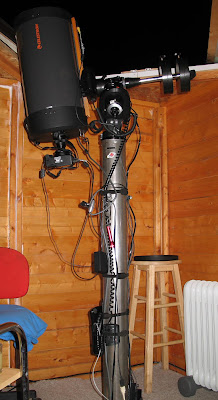


Homemade bracket for guide scope, homemade guidescope using 200mm Tamron telephoto lens and my DMK CCD camera with a 2x barlow lens afixed to the barrel.
Also note my homemade heater strip.
I ran out of money!


M51 was straight up!


Homemade bracket for guide scope, homemade guidescope using 200mm Tamron telephoto lens and my DMK CCD camera with a 2x barlow lens afixed to the barrel.
Also note my homemade heater strip.
I ran out of money!


Guiding with PHD Guiding
Here's a graph output from PHD Guiding software, used to guide my AS-GT mount and Celestron 9.25 scope.
This is a great piece of free software, that along with DSLR Shutter really makes life easy when taking long exposures using a DSLR camera. I'm sitting here writing this entry while the software does all the work, all I have to do is monitor the guiding by keeping an eye on the graph and watch the images come in :-)

This is a great piece of free software, that along with DSLR Shutter really makes life easy when taking long exposures using a DSLR camera. I'm sitting here writing this entry while the software does all the work, all I have to do is monitor the guiding by keeping an eye on the graph and watch the images come in :-)


M92 6th May 2008
Here's M92 from last night. The seeing was average and the sky was a milky colour all night. I suppose a globular cluster was a good choice to shoot.


Subscribe to:
Posts (Atom)


